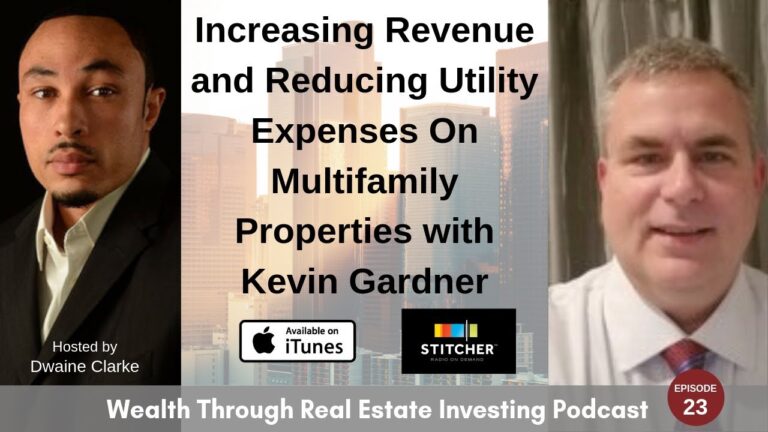
After decades working for cable companies and both negotiating and overseeing the departments that negotiated multifamily access agreements with property owners, Telecom Marketing Strategies began to offer the benefit of this experience to multifamily property owners. As demand grew, property owners requested assistance with their other utilities and Multifamily Utility Solutions was born. Multifamily Utility Solutions now does business throughout the US for multifamily property owners with as few as 50 units and others with thousands of units. To learn more about what we do at Onyx click the link below:
https://onyxcapitalinvestments.com/
00:00:03 – 00:01:44
Introduction to podcast and guest Kevin Garner
00:00:03 – 00:01:44
The podcast ‘Generational Wealth Through Commercial Real Estate’ is hosted by Will Smith, a former NFL player turned commercial real estate investor. Each episode features industry experts sharing insights on investing in commercial real estate to build generational wealth. In this episode, Will introduces Kevin Garner from Multi-Family Utility Solutions, who discusses strategies to save money by increasing revenue and reducing utility expenses. They exchange greetings and express optimism for the upcoming year, reflecting on a successful 2019 and anticipating continued growth in 2020.
00:01:11 – 00:03:01
Kevin’s background with Comcast and multifamily utilities
00:01:11 – 00:03:01
The speaker shares their background, explaining that they worked for Comcast for many years managing negotiations with multifamily properties like apartments, homeowners associations, condominiums, and mobile home parks to secure access rights for service. After leaving Comcast, they founded Telecom Marketing Strategies, the parent company of Multifamily Utility Solutions, which worked as a third-party contractor for clients including Charter Spectrum and Comcast before these companies brought the work in-house.
00:02:24 – 00:04:37
Transition to representing property owners
00:02:24 – 00:04:37
The speakers describe how their experience led them to represent property owners in negotiations to secure compensation for property use rights. Initially focused on cable and internet services, they expanded their offerings to include utilities like electric and gas by collaborating with a broker. For trash services, they refer clients to a specialized colleague who, in turn, refers cable and internet inquiries back to them, creating a complementary partnership. This evolution highlights their growth and adaptation to meet the diverse needs of property owners effectively.
00:04:05 – 00:07:20
Why property owners need utility agreements
00:04:05 – 00:06:13
The discussion explains why more people are not using services like theirs, mainly due to lack of awareness, especially among new multifamily property owners who believe they don’t need agreements if they don’t pay for resident cable. The speaker clarifies that while cable companies like Spectrum have city franchise rights to operate in public areas, they must have agreements to access private property. In single-family homes, residents give permission, but in multifamily properties, the owner acts as a gatekeeper, requiring separate agreements to allow service on the property.
00:05:40 – 00:07:20
Multi-family property owners often face challenges because original agreements with cable companies may have been lost, expired, or never properly filed due to property and company ownership changes. This creates an opportunity to renegotiate terms and establish new agreements, which can benefit property owners by clarifying obligations and conditions for cable companies’ access while potentially generating additional revenue. The conversation also briefly touches on the concept of unit accounts related to this process.
00:06:50 – 00:09:34
Leveraging multiple properties for better deals
00:06:50 – 00:09:34
The speaker explains the strategy of collaborating with multiple property owners to increase bargaining power when negotiating with cable companies like Spectrum, Comcast, or Cox. By pooling units from different owners, they create leverage that results in better proposals. For example, in Dallas, combining 1,600 units from various owners led to an offer twice as high as what a single owner with 74 units had initially received. This cooperative approach benefits both owners and cable companies by streamlining negotiations and providing longer-term contracts for properties.
00:09:05 – 00:12:21
Examples of compensation and revenue sharing
00:09:05 – 00:11:18
The speaker explains two types of compensation when partnering with a cable company for a 100-unit property: a one-time door fee or signing bonus paid within 90 days of contract signing, and ongoing revenue share paid quarterly. Revenue share is commission-based, with percentages increasing as more residents subscribe, potentially multiplying the revenue significantly as both the number of customers and commission rates grow.
00:10:46 – 00:12:21
Owners often prefer cable service over satellite dishes due to better aesthetics, reliability, and customer support from large cable companies. Cable providers also tend to maintain up-to-date technology. The discussion hints at potential property rules limiting service options, raising the question of legal restrictions on allowing only cable in a community.
00:11:49 – 00:13:41
Legal aspects of restricting satellite dishes
00:11:49 – 00:13:41
The speaker clarifies they are not a lawyer and not providing legal advice, but shares experience regarding lease agreements that restrict satellite dishes. They note some property owners include clauses prohibiting dishes in their leases. However, new owners must be cautious, as existing tenants may have active contracts with providers like DirecTV. Forcing tenants to remove dishes before their contracts expire could lead to legal complications, so lease renewals and contract terms need careful consideration.
00:13:04 – 00:16:28
Due diligence and cable agreements in property sales
00:13:04 – 00:14:37
The speaker discusses how their service adds value to properties and highlights instances where property owners approach them during due diligence to uncover existing agreements. They explain a specific case where a new owner discovered that the previous owner had been approached by a cable company but no contract was in place, emphasizing that such agreements often go unnoticed during property transactions.
00:14:08 – 00:15:41
The conversation continues about the challenges of missing cable contracts during property sales. Sometimes previous owners do not transfer cable agreements simply because they never received them, not due to any intent to deceive. The speaker notes the importance of contacting their service early to verify any agreements with cable companies, sharing that they operate on a commission basis only, receiving payment when the client profits.
00:15:06 – 00:16:28
They further explain their commission-based model, which aligns their interests with clients’ success, fostering long-term relationships. An example is given about a bulk service agreement where the property owner pays for all residents’ cable service, simplifying billing and reducing collections issues for the cable company. This arrangement benefits both property owners and service providers by streamlining payments.
00:16:01 – 00:19:04
Bulk service pros and cons for property owners
00:16:01 – 00:18:19
The speaker explains a situation where an apartment owner was reluctant to take on bulk cable service liability due to low occupancy rates around 75-80%. The owner wanted to renovate and increase occupancy before committing to paying for all units regardless of usage, which is a downside of bulk agreements. However, there was an opportunity to cancel the existing agreement during an auto-renew period before the new owner took possession. This allowed the old owner to cancel the contract, enabling the new owner to enter a fresh agreement, which proved successful.
00:17:44 – 00:19:04
The discussion shifts to the benefits of having a single cable bill for an entire apartment community. Different owners view this differently, but one key advantage is that it serves as an amenity that can attract residents. Offering bundled cable and internet service at a fixed cost can make the property more appealing compared to nearby complexes without such amenities, potentially influencing prospective residents’ decisions.
00:18:23 – 00:20:31
Benefits of bundled cable/internet for residents
00:18:23 – 00:20:31
The discussion centers on pricing strategies for cable and internet services in multifamily properties. It highlights the balance between offering bundled services at a fixed rate versus residents choosing their own providers to save money. The speaker emphasizes the importance of understanding the specific market, property, and resident preferences, as well as the variability in agreements based on the number of units and local conditions. The goal is to create value by potentially providing amenities that competitors lack while managing the risks and costs associated with service contracts.
00:20:01 – 00:22:06
Factors affecting cable agreements and goals
00:20:01 – 00:21:36
The discussion centers on the competitive nature of cable providers and how they evaluate return on investment based on the number of units and customers in a property. Cable companies assess each property individually, considering factors like market specifics and the property owner’s goals, such as bulk services, revenue sharing, or door fees. The speaker emphasizes the importance of understanding these details before negotiating any deals.
00:21:04 – 00:22:06
The conversation highlights the value provided to apartment owners by tailored cable service solutions and expresses an intention to continue collaboration and communication in the future. The speaker encourages apartment owners listening to the podcast to engage and share their goals and property details to receive the best possible service offers.
00:21:34 – 00:24:16
How to contact Kevin and build relationships
00:21:34 – 00:23:19
The speaker shares their contact information, emphasizing that the best way to reach them is via their website and email. They discuss regularly educating people about investment opportunities, mentioning a recent conversation with someone interested in a 104-unit property in Savannah, Georgia, which won’t close until the new year. The speaker highlights how they provide insights and maintain ongoing discussions about potential deals.
00:23:16 – 00:24:16
The speaker recounts attending conferences and building long-term relationships, including one example where a person initially owning just two duplexes later scaled up to 350 units after consistent education and support. This relationship has led to partnerships and referrals, illustrating the value of investing time in educating and connecting with people, which often results in mutual benefits and growth.
00:23:46 – 00:24:31
Closing remarks and podcast outro
00:23:46 – 00:24:31
The host wraps up the podcast episode by expressing appreciation and encouraging listeners to stay in touch. They wish everyone success for the year 2020 and thank listeners for tuning into the Generational Wealth Through Commercial Real Estate podcast, sponsored by Onyx Capital Investments. The company collaborates with investors nationwide to invest in income-producing real estate in emerging markets. Listeners are invited to connect online to learn more and to leave a review if the podcast has added value to their lives.